
Cold Email vs LinkedIn: Which Prospecting Channel to Choose First
I break down the two most used B2B prospecting channels in Spain: cold email and LinkedIn. Response rates, costs, risks and which one makes sense for your business.
Updated: 2026-08-15
 Pablo Giménez·Lead analyst · LinkedIn prospecting

Featured tool
Waalaxy
Cold email or LinkedIn: which to pick in 30 seconds
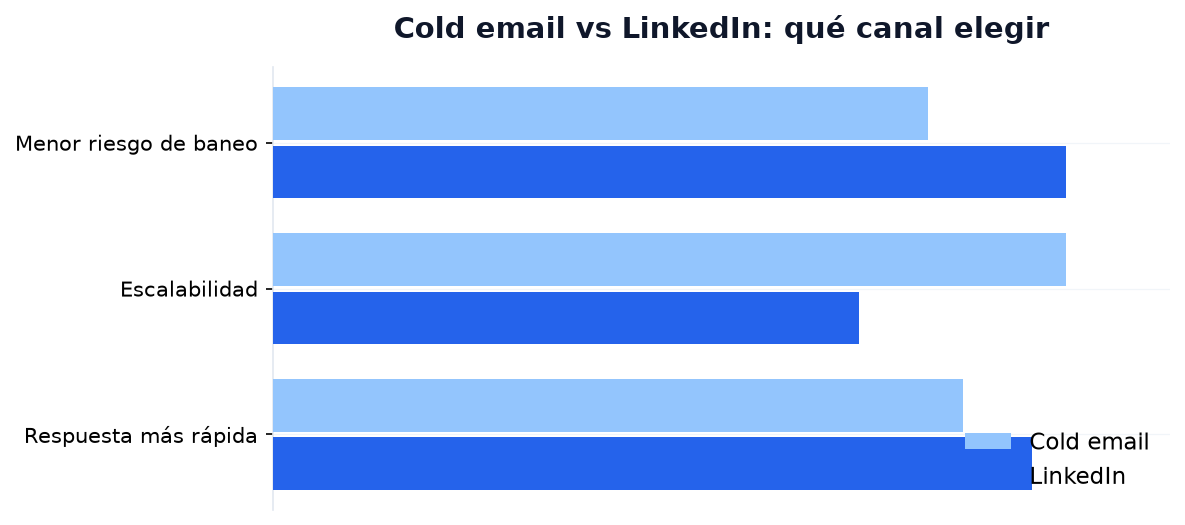
For B2B prospecting in Spain, LinkedIn usually delivers better results than cold email: higher acceptance rates and less risk of your messages ending up in spam. Cold email pays off when you already have volume, a verified list and a warm domain. My recommendation is to start with LinkedIn.
Now let me explain why, because the answer depends a lot on who you sell to and how much you want to scale.
Why they're different channels
If you already know Waalaxy is your option, you can start free here and see if it fits your team.
LinkedIn is a social network built for professional contact. When you send someone an invitation, that person sees your photo, your job title, your company and your mutual connections before deciding whether to accept. There's a social context that builds trust from the first second.
Cold email is different. You write to an email address that doesn't know you at all, competing with dozens of messages in a saturated inbox. Your email has to earn the open with the subject line and the reply with the first few lines, and all of that only if it didn't land in the spam folder first.
The core difference is trust. On LinkedIn, trust comes from your profile. With email, you have to build it with your copy, and that's harder.
Realistic response rates
On LinkedIn, a well-run campaign usually gets invitation acceptance rates between 20 and 40 percent. Of those who accept, a share replies to your follow-up message. The funnel feels natural because the person chose to accept you.
With cold email, good open rates sit around 30 to 40 percent, and reply rates land between 2 and 8 percent in the best case. Mind you, these are ballpark figures. They depend enormously on your list, your offer and how warm your domain is.
What is constant is the ceiling. Cold email punishes you fast if your domain doesn't have good reputation, and rebuilding that reputation takes weeks.
Costs and effort
LinkedIn is cheap to start. With a decent profile and a tool like Waalaxy, which has a free plan with 50 invitations a month, you can validate the channel for almost nothing. The effort goes into polishing your profile and writing personalized messages that don't sound like templates.
Cold email requires more upfront investment. You need your own domain, SPF, DKIM and DMARC setup, weeks of domain warmup and a verified email list from a tool like Hunter. Skip any of those steps and your emails don't even reach the inbox.
The risk of each channel
On LinkedIn, the risk is getting your account restricted if you overdo the automation or send mass invitations to strangers. The fix is using a tool that respects the limits and not behaving like a robot.
With email, the risk is landing in spam or getting reported as a nuisance sender. Once your domain falls onto a blocklist, sending emails becomes an uphill battle. It's a silent risk that many people discover too late.
When to choose LinkedIn first
Choose LinkedIn if you sell services or mid-to-high ticket products, if your ideal customer is active on the network and if you prefer quality over quantity. That's the case for consultants, agencies, recruiters and freelancers.
It's also the best option if you're starting out and don't want to build the whole email infrastructure. Validating your sales message is faster on LinkedIn, and feedback comes sooner.
When to choose cold email
Choose email if you need to reach thousands of people, if your list is already verified or if you sell something low ticket that doesn't justify a long conversation. Also if your audience isn't on LinkedIn, which happens in some industrial sectors.
And choose email if you already have a domain with reputation and experience setting up SPF, DKIM and DMARC. Without that, don't start here.
The strategy I would use
I would start with LinkedIn to validate my offer and my messages. It's cheaper, faster and less risky. Once I have conversations going and know which angle works, I'd move to cold email to scale the volume.
The ideal setup is multichannel. Reaching out on LinkedIn and email at the same time multiplies your chances of a reply. Tools like Waalaxy support campaigns that mix both channels, and that's the way to go once you have some mileage.
Typical mistakes in each channel
On LinkedIn, the most common mistake is selling in the invitation. You send a request and, in the same message, you're already pitching your offer. That gets you rejections and reports. The invitation should only open the door. The sales message comes later, once they've accepted you.
Another frequent mistake is a neglected profile. An unprofessional photo, an empty headline or an experience section left blank kills your acceptance rate. Before automating anything, spend an afternoon making your profile spotless.
With cold email, the classic mistake is the long, generic message. Paragraphs of introduction, filler sentences and a lukewarm close. If the recipient can't understand in three seconds what you want and why it matters to them, they delete the email. Be brief and get to the point.
The other mistake is not cleaning the list. Buying cheap databases or using unverified emails spikes bounces and burns the domain. A small, clean list outperforms a huge, dirty one.
Which metrics to watch in each channel
On LinkedIn, your two key numbers are invitation acceptance rate and reply rate to your follow-up messages. If acceptance drops below twenty percent, review your targeting and your profile before touching anything else.
With cold email, watch opens, replies and bounces. Opens tell you if your subject line works. Replies tell you if your message and offer work. Bounces tell you if your list and domain are healthy. Each number points to a different problem, and you have to read them separately.
The golden rule is to change one variable at a time. If you touch the subject line, the list and the message all at once, you'll never know what worked.
Final verdict
For most B2B professionals in Spain, LinkedIn is the channel to start with. More trust, less risk and a minimal cost of entry.
Cold email isn't bad. It's a powerful channel, but it demands more preparation and it pays off once you already have volume and a clean list.
My advice. Start with LinkedIn, validate your message with a hundred conversations, then add email as a second channel. Not the other way around.
Written by
Pablo Giménez
Lead analyst · LinkedIn prospecting
6+ years prospecting on LinkedIn for agencies and SaaS. He tests every tool with real accounts before sharing his opinion, and writes so you do not repeat his mistakes.
Specialty: LinkedIn automation, Waalaxy, account safety