
Apollo.io: The Complete Guide (2026)
Apollo.io is a B2B sales platform with a database of 240+ million contacts, a built-in CRM and cold email sequences. I break down its plans, pricing and real user reviews so you know if it's worth it in 2026.
Updated: 2026-08-26
 David Ortega·Analyst · Data and B2B databases

Featured tool
Apollo.io
What Apollo.io is, in short
Apollo.io is a B2B sales platform that combines a database of 240+ million contacts, a built-in CRM and cold email sequences in one tool. The free plan includes 75 credits per month, and paid plans start at $49 per user per month billed annually.
What is Apollo.io
Apollo.io is one of the most widely used B2B sales platforms in the world, with more than a million professionals on it according to its own website. It was founded in 2015 in San Francisco, and the company describes itself as a platform valued at $1.6 billion.
The pitch is ambitious. Instead of buying a database on one side, a CRM on another and an email tool somewhere else, Apollo puts everything on a single screen. You search contacts, verify emails, build sequences, manage the pipeline and make calls without leaving the platform. Nobody else does that in its price range.
The key question is whether that level of concentration actually works, or whether, as often happens, you end up paying for modules you never use. I've been testing it for months with real accounts, and I'll tell you upfront that the answer is more nuanced than it looks. Let's get into the data.
What Apollo.io is for
1. Contact database
The heart of Apollo is its database. According to its official website, it holds more than 240 million contacts and around 35 million companies, with direct emails, phone numbers and employment data.
The filters are among the most complete I've tested in this category. You can search by job title, industry, company size, tech stack, location or headcount growth. In practice, that means you can pull every marketing director at SaaS companies with 50 to 200 employees in Spain, with their corporate email, in under five minutes.
2. Verification and enrichment
Not everything in the database is gold, and Apollo knows it. The tool tells you how likely an email is to be valid and lets you enrich your own lists. You upload a CSV with 1,000 companies and it fills in the missing contacts using multiple sources, what they call waterfall enrichment. You can feel the difference in quality.
That said, every email or phone number you look up costs credits. Exporting a contact out of Apollo costs credits too. That's their business model, and it's worth knowing from day one.
3. Cold email sequences
Apollo includes a sequences module that competes with dedicated tools like Instantly or Smartlead. You can build multichannel sequences with emails, calls and tasks, schedule automatic follow-ups and connect your own sending infrastructure.
The deliverability suite includes warmup on paid plans, something that only pure email tools offered two years ago. If you're coming from the cold email world, I recommend my article on what cold email is for context, and this one on how to warm up a domain so you don't crash on your first send.
4. CRM and pipeline
Apollo's CRM is simpler than Salesforce, but it gets the job done. You manage leads, opportunities, pipeline stages and basic automations. For a small team that doesn't want to build a stack of five tools, that's a very solid argument.
5. Artificial intelligence
Apollo has put its foot on the accelerator here. It has an AI assistant, automatic account research, lead scoring and something called Agentic Loops, which automates entire prospecting tasks. The free plan already includes an assistant with five chats per month, and paid plans get more generous usage.
The AI works reasonably well, but don't expect magic. It's still a way to do faster what you already know how to do, not a substitute for commercial judgment.
How much Apollo.io costs in 2026
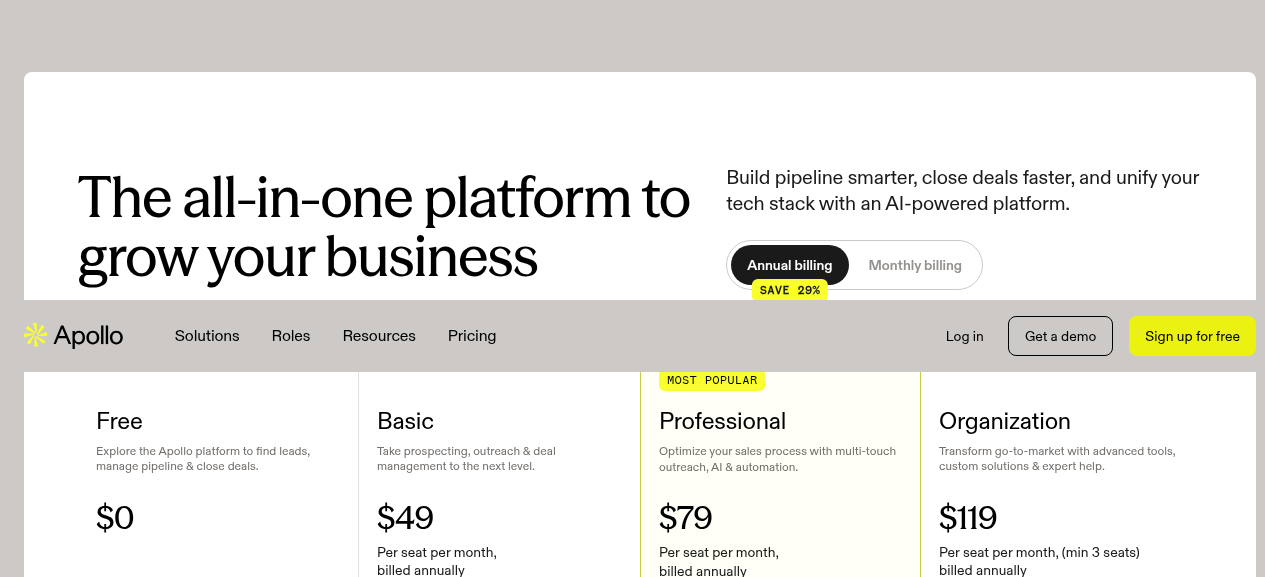
These are the official prices from Apollo's website as of August 2026. Billing annually saves you 29%.
| Plan | Price | Credits | Highlights |
|---|---|---|---|
| Free | $0 | 75 per month | 2 sequences, limited AI assistant, Chrome extension |
| Basic | $49 per user/month | 2,500 per month | Unlimited sequences, warmup, advanced filters |
| Professional | $79 per user/month | 4,000 per month | A/B testing, automations, analytics, AI calls |
| Organization | $119 per user/month | 6,000 per month | SSO, advanced security, 12 intent topics, min. 3 users |
With monthly billing, prices go up to $69, $99 and $149 respectively. The Organization plan is only available with annual billing and has a three-user minimum, so even if you only need two accounts you pay $357 per month.
One detail worth appreciating: Basic and Professional both come with a 14-day trial, plenty of time to run a real campaign and see if the tool delivers.
How credits work
This is the part nobody explains and the one that causes the most scares. Each plan gets a monthly credit allowance, and every data action has a cost. Looking up an email or phone number costs credits, exporting a contact costs credits, enriching a CSV costs credits. Sequences, the CRM and sending emails cost nothing.
On the free plan, 75 credits disappear in a blink if you start checking emails seriously. That's why Apollo's free plan is for evaluating the tool, not for real prospecting. With Basic you get 2,500 credits a month, which is 2,500 enriched contacts if you don't export.
When you run out, you can buy more credits any time from your dashboard, and Apollo warns you before you hit zero. The system isn't a trap, but you should know what you're paying for before you export whole lists.
What the real reviews say
There's an interesting contrast here. On G2, Apollo scores 4.7 out of 5 with more than 9,600 reviews, one of the best in the industry. On Trustpilot it drops to 3.1 out of 5 with 1,269 reviews. The difference explains itself once you read the criticism: people love the product, not the support.
What gets praised the most is the value for money compared to ZoomInfo, the corporate alternative that costs thousands of dollars a year. One user summed it up in January 2026: at his company only long-tenured people get ZoomInfo, but with Apollo he finds the data he needs at a price his department can actually justify.
Another recurring point is database coverage. In a February 2026 review, a user said he finds almost every lead he looks for, and there's always at least one reference contact per company.
The complaints repeat themselves too. Technical support is slow and sometimes unhelpful. The learning curve is real: in a July 2026 review, a customer asked for a full-day in-person session because the tool is so big he didn't know where to start. And there are occasional stability issues, with sessions closing on their own and fields that don't always fill in.
Translation: the product is solid, but don't expect top-tier support or to master it in an afternoon.
Pros and cons
The good:
- Huge database with very powerful filters
- All-in-one: data, email, CRM and calls
- Unbeatable price compared to ZoomInfo
- Free plan to try without paying
- The AI is advancing fast and is already useful day to day
The bad:
- The credit system is confusing and runs out fast
- Weak technical support, the most repeated complaint on Trustpilot
- Steep learning curve
- The CRM falls short if the team grows a lot
- The free plan isn't enough for real prospecting
Apollo.io and Waalaxy: why they complement each other
A question I get a lot is whether Apollo replaces Waalaxy or the other way around. They don't replace each other, they complement each other. Apollo is a cannon for data and email. Waalaxy is LinkedIn automation, with a free plan of 50 invitations a month and a visual editor that lets you build a campaign in five minutes without risking your account.
My recommendation for the Spanish market: start with Waalaxy free and validate whether LinkedIn gets you conversations. When you need data volume or want to run cold email at scale, add Apollo to the stack. It's all explained in my Waalaxy vs Apollo comparison, and if direct emails are your thing, in this list of tools for finding emails I compare Apollo with Hunter and company.
How Apollo.io works
The usual workflow in Apollo goes like this.
You start in the contact finder. You build your search with the filters, look at the results with their match score and their valid email probability, and save the ones you like to a list. Every time you check an email or a phone number, you spend a credit. It's important to be clear on that from day one.
Then you move on to sequences. You create a campaign, assign it your lead list, and Apollo sends the emails with your scheduled follow-ups. The deliverability module includes automatic warmup for your accounts and metrics on which emails hit the inbox.
Meanwhile, the CRM logs all the activity. When a lead replies, they move through your pipeline. You can add tasks, log calls, and leave notes. Everything stays in one place, which is exactly the tool's promise.
On top of all that sits the AI layer. Apollo has an assistant that researches accounts, scores leads, and automates complete prospecting tasks with its Agentic Loops. It works reasonably well, but don't expect magic. It's still a help to do faster what you already know how to do.
Tips before you start
If you open an account, take my advice on three things. Don't export whole lists on day one, credits fly by and then you have no room left to test. Use waterfall enrichment for your own lists before launching campaigns, because the quality of your own data is usually better than mass data. And always verify the critical emails. Even though Apollo has its own verification, running your important contacts through an external verifier saves you bounces and reputation issues. If you're going to run cold email, I recommend reading my guide on how to warm up a domain first.
Final verdict
Apollo.io is the best value for money in the B2B data market in 2026. For $49 a month you get a database that cost four figures four years ago, plus sequences, warmup and CRM included.
But it's not for everyone. If you're a freelancer who prospects mostly on LinkedIn, Apollo is overkill and will confuse you more than it helps. There, Waalaxy wins: cheaper and more direct. If you sell to companies, work with volume or run a sales team, Apollo pays for itself with the first leads you find.
My practical advice: open the free account, search your market with the filters and check the data quality. If the tool convinces you, the annual Basic plan is the most sensible price-feature combination out there right now.
Written by
David Ortega
Analyst · Data and B2B databases
Former SDR and data obsessive. He compares contact databases, email verification and enrichment tools with numbers on the table.
Specialty: B2B databases, Apollo, Hunter, verification